Scyphers Lab at the University of South Alabama
Welcome to the Social-Ecological Sustainability Lab of Associate Professor Steven Scyphers
We study coastal development, fisheries management, and climate adaptation. From a social-ecological systems perspective, our interdisciplinary research is problem-and-solution focused and strives to develop strategies for sustaining both coastal ecosystems and societies.
LATEST UPDATES
New Project on Alabama Saltwater Recreational Fisheries (AL Creel) ! In collaboration with the Alabama Department of Conservation and Natural Resources, Marine Resources Division (MRD), the Scyphers Environment and Society Lab is supporting the Alabama Creel program. This project collects vital data on saltwater recreational fishing across Alabama’s coastal and offshore waters to improve fisheries management and sustainability.
New Project on the Mobile Naval Yard Expansion!
In collaboration with partners across the University of South Alabama and Northeastern University, this project examines the planned expansion of the Mobile Naval Yard and its impacts on the local community. The team is conducting interviews with key community stakeholders to understand perspectives on maritime industry growth and how it may affect areas such as workforce development, local infrastructure, and community resilience. This work also explores the role of higher education institutions and community engagement in supporting sustainable and equitable outcomes as the region prepares for new shipbuilding and defense-related investments.
New Project on Direct Air Capture in Mobile County (SEDAC Hub)!
In collaboration with regional partners, the Southeast DAC (SEDAC) Hub is supporting early-stage planning for deploying direct air capture technology in Mobile County. This project includes completing engineering and design studies for two DAC systems capable of removing 100,000 tonnes of CO₂ annually, assessing shared infrastructure and low-carbon energy needs, and identifying long-term CO₂ storage options. The team is also conducting interviews with key community stakeholders to gather insights on housing, transportation, health care, education, and environmental impacts related to DAC development.


WHAT WE STUDY


COLLABORATIVE SCIENCE
The complex dynamics and sustainability challenges of coastal SES cannot be fully understood or solved without effectively integrating communities and key stakeholders. Our research has focused on understanding the costs, benefits, and effectiveness of public participation in science and management. We are particularly interested in participatory modeling and conservation.
SHORELINES
Along coastlines, coastal societies and marine ecosystems represent highly dynamic and critically important social-ecological systems (SES). Our research focuses on understanding the context and consequences of coastal management decisions, with an emphasis on natural, built, and hybrid shorelines.


FISHERIES
Marine and coastal fisheries, another highly dynamic and important SES, support diverse livelihoods, recreational opportunities, and food security. Our research focuses on the human dimensions of fisheries, and we are particularly focused on understanding influences on fishing behavior and the social impacts of fisheries management actions.
DISASTERS
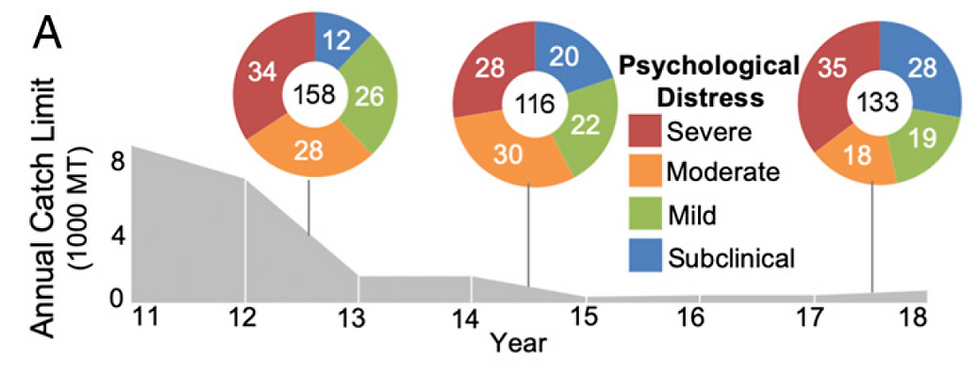
On the front lines of diverse natural and technological hazards, coastal communities are uniquely prone to disasters. Our research has focused on understanding how social-ecological dynamics influence vulnerability, resilience, and recovery. These studies have included the BP Oil Spill, Northeast U.S. groundfish fishery failure, Apalachicola Bay ecosystem collapse, and the impacts of hurricanes on coastal communities. Our most recent work focuses on the impacts of Hurricane Irma in the Florida Keys and St. Maarten.